If you’re looking to visit a new trail or revisit an old favourite, here is a list of Thames Talbot Land Trust’s public access trails. While you’re enjoying all the trails, protect the land you love by recording your species observations through our iNaturalist projects, which contributes to our knowledge of these special places.
Please note that all group visits to and activities on a TTLT nature reserve must be approved by TTLT prior to the event. Please contact us to request a group visit.


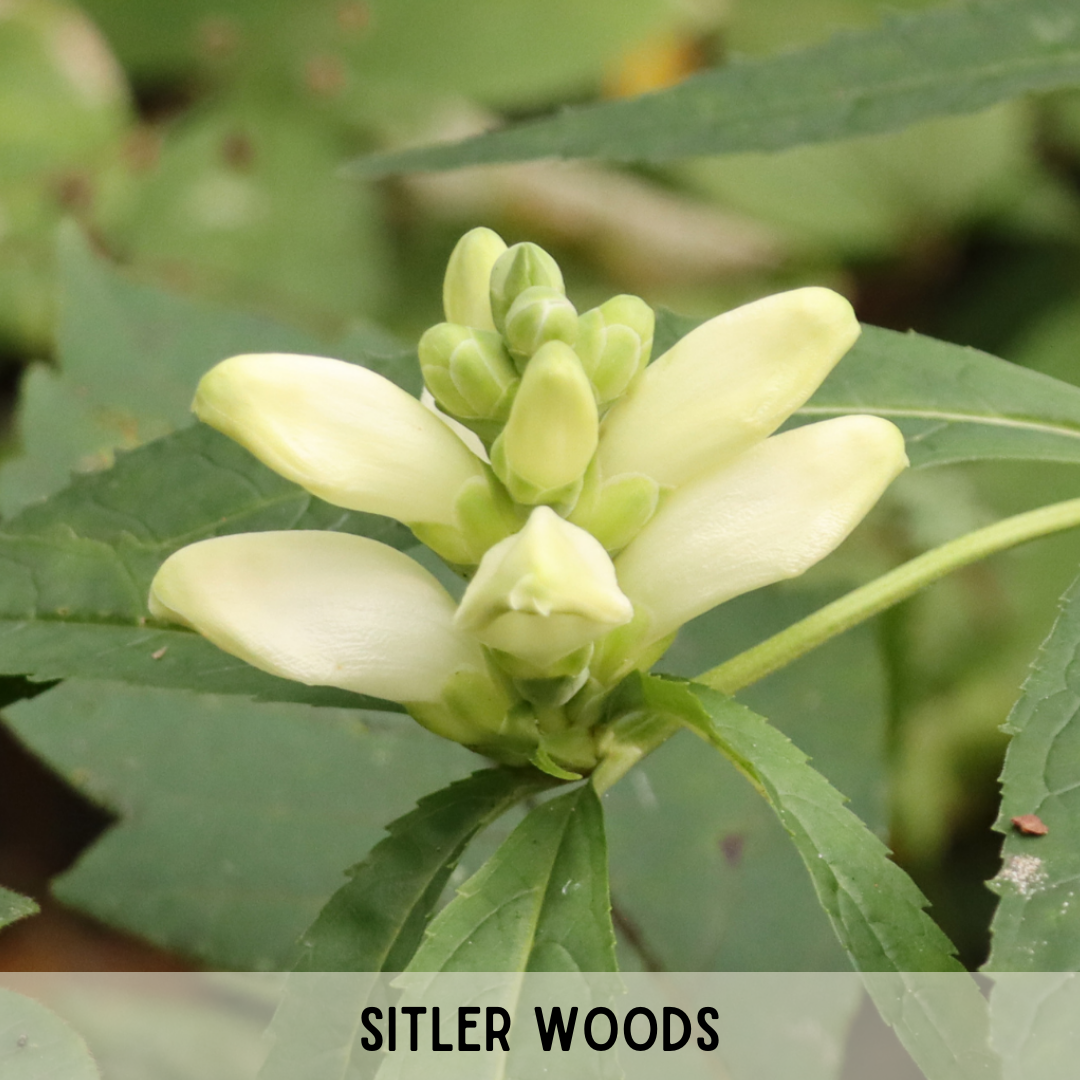
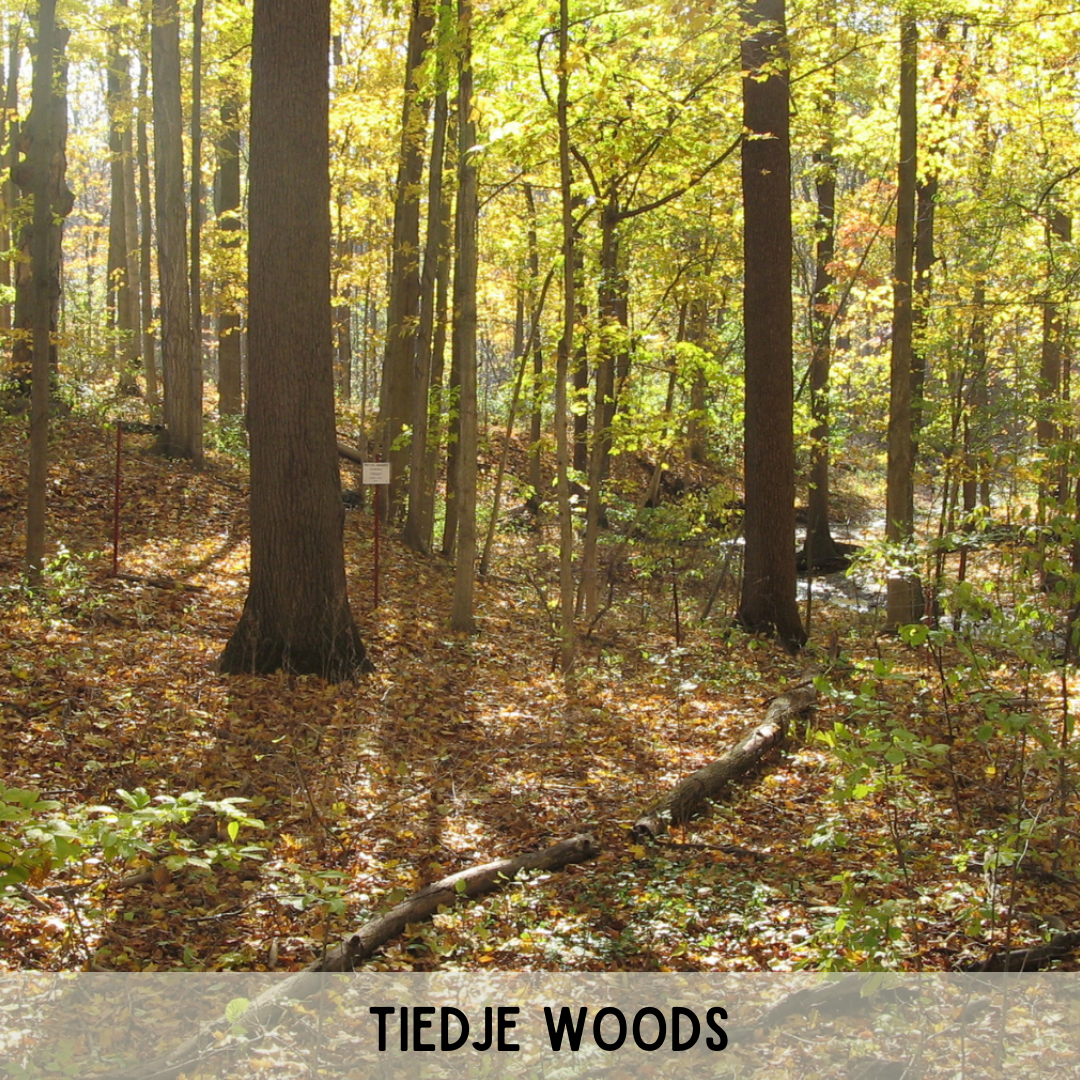

Photos: Five Points Forest landscape (Daria Koscinski), Hawk Cliff Woods landscape (John St. Pierre), Joany's Woods boardwalk (David Wake), Meadowlily Nature Preserve bridge (Colin Johnson), Sitler Woods White Turtlehead (David Wake), Tiedje Woods Forest landscape (Cathy Quinlan), Wardsville Woods landscape (John St. Pierre), .
Five Points Forest - Driedger Tract
Location: 4975 Robinson Road, Putnam, ON
Five Points Forest Trail – approximately 2.5 km
This stunning nature reserve features a range of Carolinian Zone habitats, including a meadow, young and mature forest, wetland, and White Pine grove. Beautiful plants you can find here include Eastern Leatherwood, Great Blue Lobelia, Swamp Thistle, and Spotted Jewelweed. Different loops mean shorter or longer hikes are available.
Difficulty: Easy
Accessibility: Trail is mostly flat, can be narrow at times, and muddy when wet.
Parking: Please park along the edge of the road adjacent to the meadow.
Record your observations to our Five Points Forest iNaturalist project.
Hawk Cliff Woods
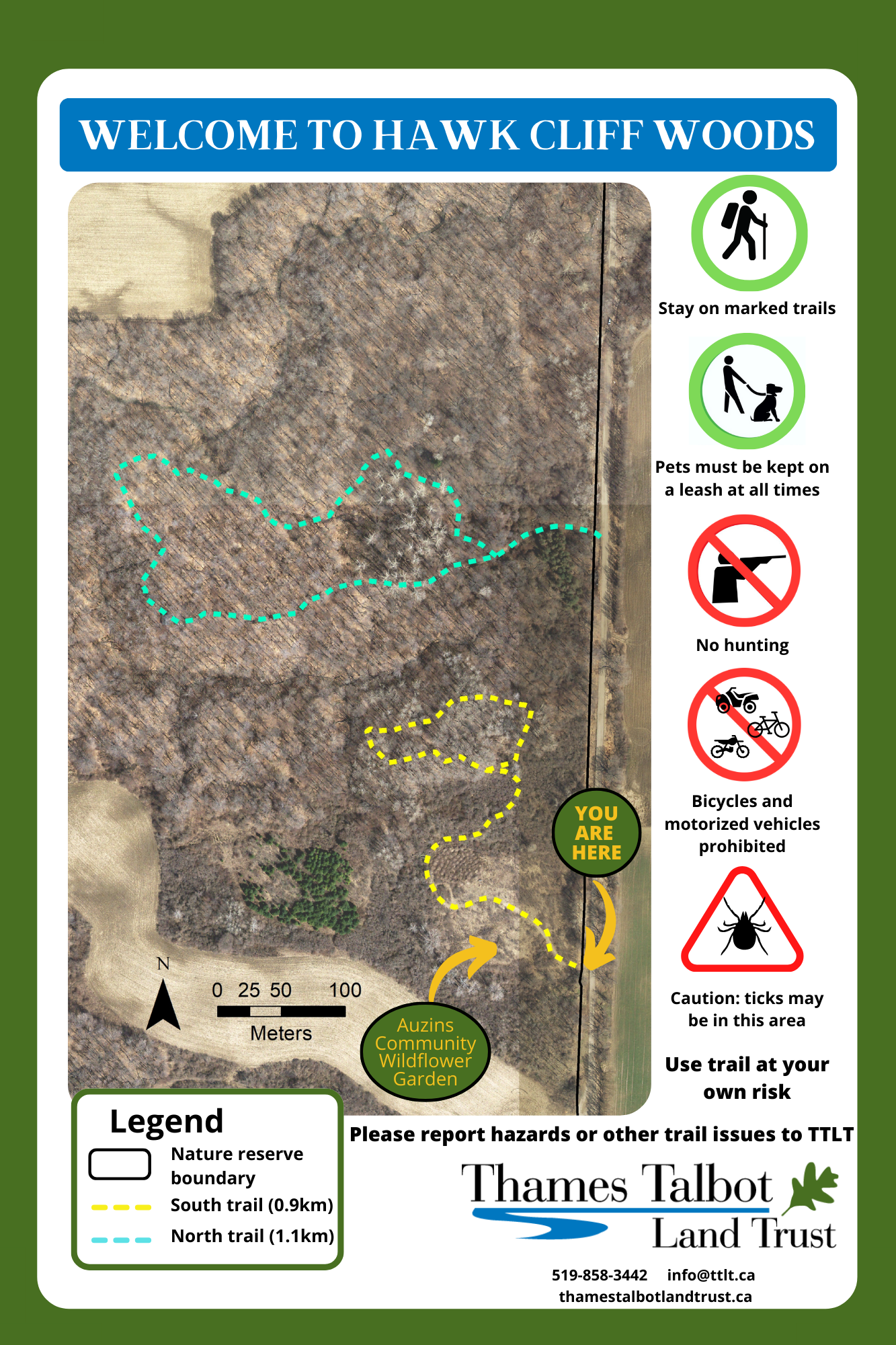
Location: North trail: 4437 Hawk Cliff Road, Union, ON and South trail: 4107 Hawk Cliff Road, Union, ON
North trail loop – approximately 1 km
This is a short but beautiful trail loop that goes through a young forest into a more mature forest. Several snakes and frogs can be spotted on this trail, and expect to see species like Pale Jewelweed and Shagbark Hickory. This trail also features ravine views.
Difficulty: Easy
Accessibility: Trail is flat and wide but will be muddy when wet.
Parking: Please park in the small parking lot located at the South trail entrance. The trail entrance is about halfway up Hawk Cliff Road on the west side of the road.
South trail loop – approximately 1 km
Although this trail is short, it takes you through several habitats including a small meadow, a Sumac and Dogwood thicket, and a forest. Bird enthusiasts have spotted several rare species at this nature reserve. You can also expect to see various stunning plants, such as Greater Fringed Gentian, New England Aster, and Compass Plant, and butterflies, such as the Monarch.
Difficulty: Easy
Accessibility: Trail is narrow at times and has some steep inclines.
Parking: Please park in the small parking lot located at the South trail entrance.
Auzins Community Wildflower Garden
The garden is planted with all native wildflowers and grasses, such as Common Milkweed and Dense Blazing Star. It is named to recognize Karen and Eric Auzins, whose generosity helped to ensure that Hawk Cliff Woods would become a protected nature reserve. Visitors are welcome to collect seeds from the garden in the Fall. Interpretive signage details each species and how to use it in gardening, as well as seed collecting instructions.
Difficulty: Easy
Accessibility: Wheelchair accessible with a wide and gravel pathway; however, not maintained during Winter months.
Parking: Please park in the small parking lot located at the South trail entrance.
Record your observations to our Hawk Cliff Woods iNaturalist project.
Hawk Cliff Woods Trail Map here.
Joany's Woods
Location: Boot Hill Road, Thedford, ON and Vernon Road, Thedford, ON
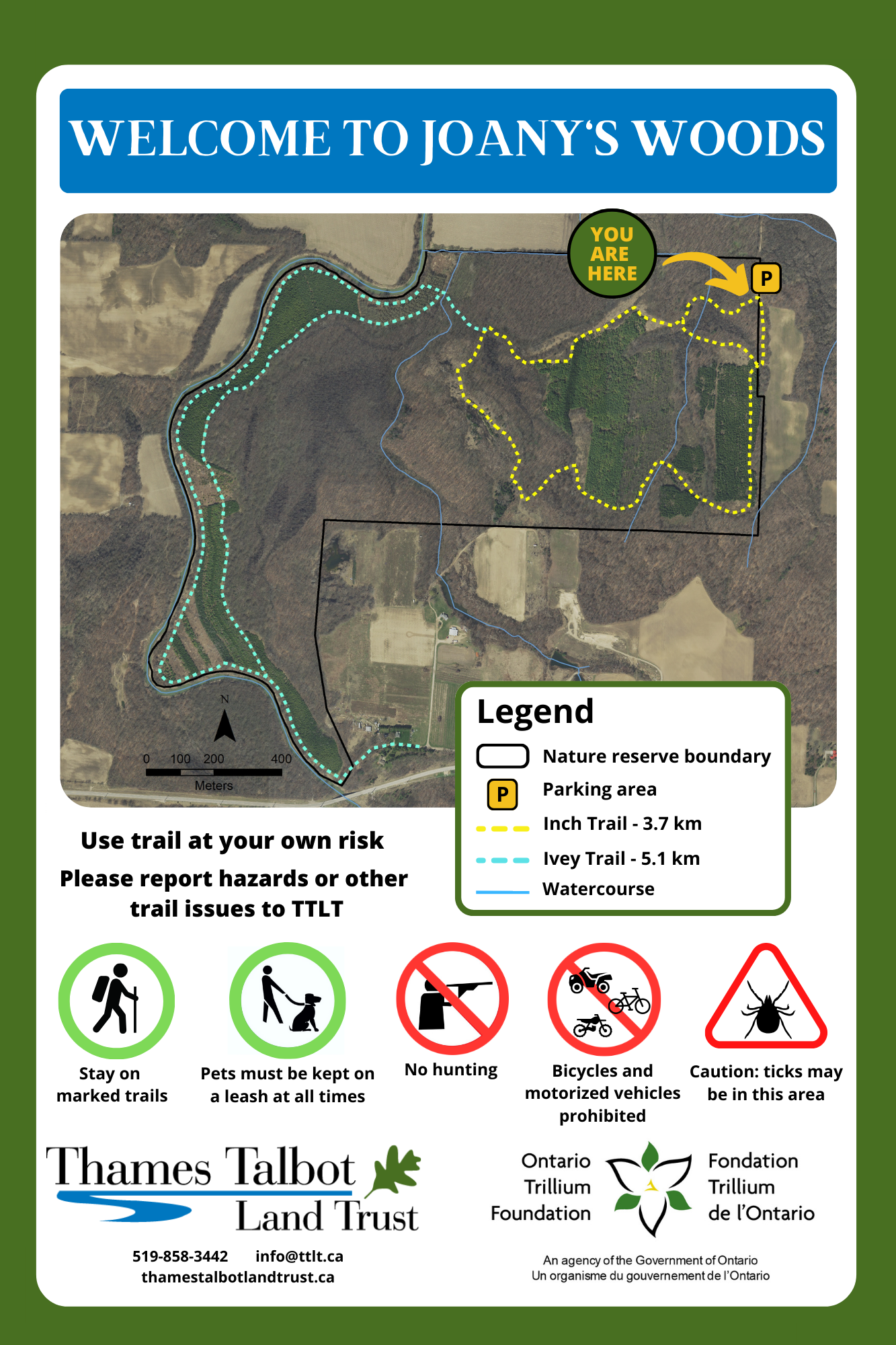
Ivey Trail – approximately 5.1 km
The Ivey Trail is named in honour of Richard and Beryl Ivey to recognize their incredible generosity to TTLT over the years. The Ivey Trail is a loop that takes you through a mixture of Carolinian forest and plantation forests, and along the banks of the Ausable River. Notable species include Michigan Lily, Tall Bellflower, and Tulip Tree, as well as a variety of fungi. It also connects with the Inch Trail if you're looking for a longer hike.
Difficulty: Easy to Medium
Accessibility: Some flat portions and slopes and is accessible via a steep hill.
Parking: Please park in the small concrete parking area located on the left of Vernon Road after the road entrance (see parking location here). To respect the nearby residents, please do not park along or on the side of Vernon Road. The trail can be accessed by foot at the end of Vernon Road.
Inch Trail – approximately 3.7 km
The Inch Trail is named in memory of Helen and Spencer Inch, whose legacy gift to TTLT helped to secure Joany's Woods as a protected nature reserve. Along this trail you can see varied habitats including woodlands, meadows, swamps, and conifer plantations. This nature reserve has an array of beautiful species, including Creeping Foamflower, Wood Anemone, and Red Columbine. The Inch Trail connects with the Ivey Trail approximately halfway around if you want a longer hike.
Difficulty: Medium
Accessibility: Some steep sections.
Parking: Please park in the small parking area located on the right of Boot Hill Road. To respect the nearby residents, please do not park along Boot Hill Road.
Record your observations to our Joany’s Woods iNaturalist project.
Joany's Woods Trail Map here.
Meadowlily Nature Preserve
Location: 17 Meadowlily Road South, London, ON
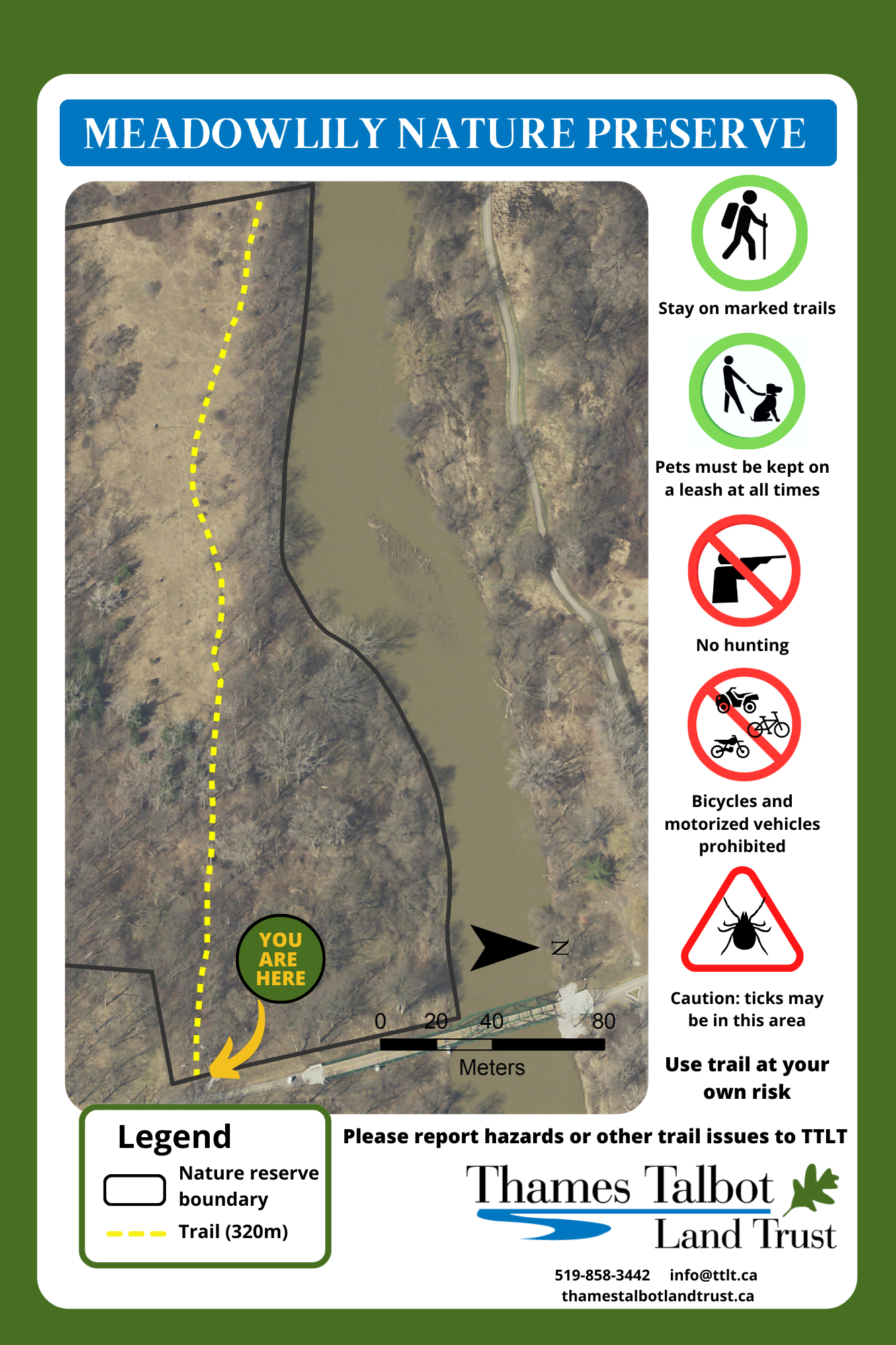
Meadowlily Nature Preserve Trail - approximately 320 m
Across the road from the Meadowlily Woods Trail, this short, easy trail takes you south along the Thames River floodplain into a butterfly meadow. TTLT is slowly restoring this area to native meadow by planting grasses and wildflowers each year with the help of local students. The meadow provides habitat and nectar for an impressive range of butterflies. Visit in July and August for the best chance of seeing these butterflies.
Difficulty: Easy
Accessibility: Flat, but the trail is narrow in certain areas.
Parking: Please park along the paved shoulder on Meadowlily Road.
Record your observations to our Meadowlily Nature Preserve iNaturalist project.
Meadowlily Nature Reserve Trail map here.
Sitler Woods
Location: Entrance 1: Dogwood Road, Newbury, ON and Entrance 2: Dogwood Road, Newbury, ON
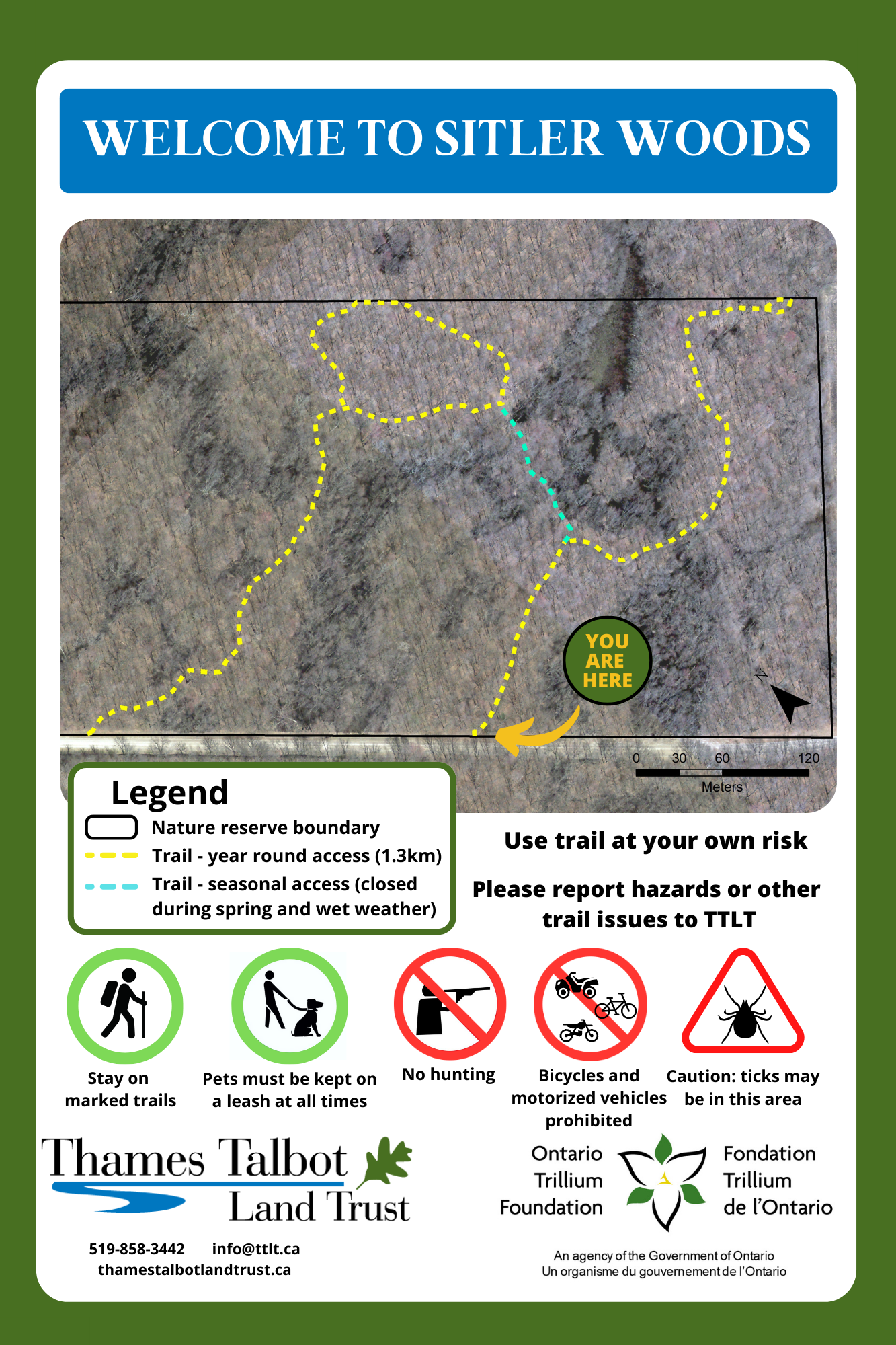
Sitler Woods Trail – approximately 1.3 km
Sitler Woods is part of Skunks Misery, a beautiful representation of the Carolinian Zone swamp mosaic that supports a variety of special species, such as Eastern Flowering Dogwood and American Chestnut. This U-shaped trail showcases mature trees and old growth forests. You can find several salamander and frog species, as well as rare birds.
Difficulty: Easy
Accessibility: Mostly flat and can be muddy when wet.
Parking: For both entrances, please park along the shoulder of Dogwood Road.
Record your observations to our Sitler iNaturalist project.
Sitler Woods Trail Map here.
Tiedje Woods
Location: 30823 Sylvan Road, Arkona, ON
Tiedje Woods Trail – approximately 100 m
This short in-and-out trail goes through the old mature forests where you can see Carolinian tree species, such as Beech and Sugar Maple. Eastern Wood-pewee and Wood Thrush can be found in this forest. There is a bench at the end where you can sit and enjoy the view and sounds of this nature reserve.
Difficulty: Easy
Accessibility: The trail is primarily a hill that goes into the forest with a bench at the end.
Parking: There is no designated parking area, so please park on the side of Sylvan Road as far off the road as possible.
Wardsville Woods
Location: 1632 Longwoods Road, Wardsville, ON
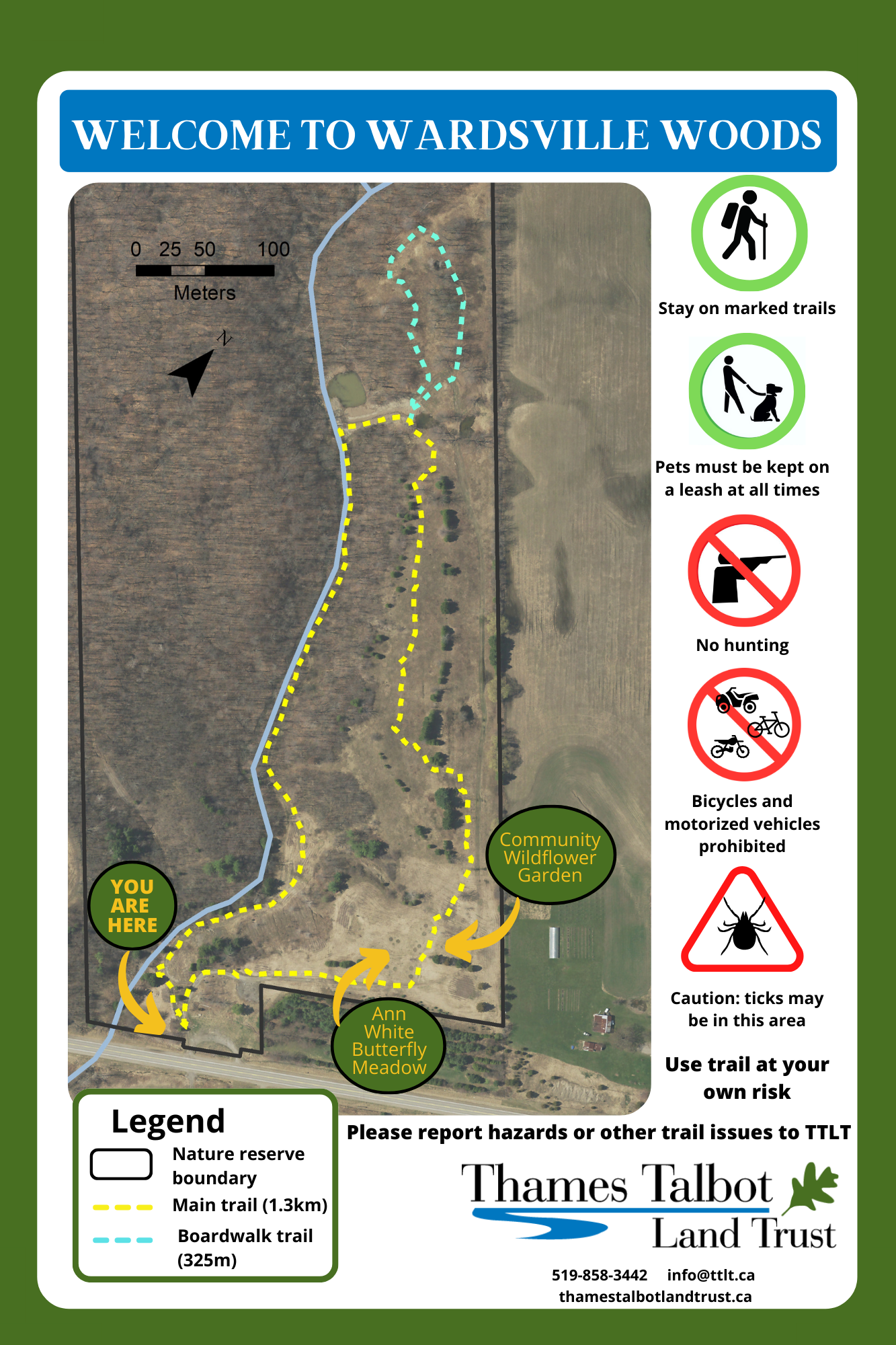
Wardsville Woods Trail – approximately 1.6 km
This trail loop takes you on a streamside walk through the edge of a Carolinian Forest and into a restored meadow habitat. Along the way you can see restored wetland habitats, a community wildflower garden, and butterfly meadow. Expect to see Butterfly Milkweed, Grey-headed Coneflower, and a variety of Asters and Goldenrods.
Difficulty: Medium
Accessibility: Some hills and areas with uneven terrain. Expect muddy areas during wet weather.
Parking: Please park in the small gravel parking area located at the nature reserve entrance.
Ann White Butterfly Meadow
The meadow is named to recognize the generosity of Ann White, long time TTLT volunteer, supporter, and donor. The meadow is a restored former golf course that now contains a range of native wildflowers and grasses, providing excellent habitat for butterflies and other pollinators. Visit in July and August for the best chance of seeing butterflies. To view the meadow, take the right entrance at the trail head.
Difficulty: Easy
Accessibility: Slight incline in the meadow and the trail is wide.
Parking: Please park in the small gravel parking area located at the nature reserve entrance.
Wardsville Woods Community Wildflower Garden
The garden is planted with all native wildflowers and grasses, such as Virginia Mountain Mint and Wild Bergamot. Visitors are welcome to collect seeds from the garden in the fall. Interpretive signage details each species and how to use it in gardening, as well as seed collecting instructions. The garden is accessed via the right entrance of the trail head.
Difficulty: Easy
Accessibility: Slight incline to the garden and the trail is wide.
Parking: Please park in the small gravel parking area located at the nature reserve entrance.
Record your observations to our Wardsville Woods iNaturalist project.
Wardsville Woods Trail Map here.
Safety Information:
Before Hiking: Understand your fitness level and pick a trail that matches this level. Tell someone where you are going, when you expect to return, and what to do if you don’t return by an agreed time. Carry identification. Check weather conditions and reports before you start out. Stay on marked paths. When in doubt of trail conditions, turn around and head back the way you came slowly and calmly. Walk in daylight hours. Bring plenty of water and a nutritious snack, insect repellent with DEET, sunscreen SPF 30+, first aid kit with a whistle and flashlight.
Terrain: Trail may contain steep, uneven, slippery, or jagged terrain, or areas where solid footing is obscured by vegetation. Be sure to wear appropriate footwear. Hiking boots are ideal, but any closed-toe shoes with good ankle support and tread should be sufficient.
Inclement Weather: We recommend you check the forecast before you go out on the trails and avoid hiking in heavy rain, thunderstorms, high winds, and extreme hot or cold weather. Wear appropriate clothing for the weather, including layers and rain gear, and remember your sunscreen.
Biting and Stinging Insects: Depending on the time of year, you might come across mosquitoes, black flies, ticks, and other biting or stinging insects. Wearing light coloured, loose fitting clothing and using insect repellent and “bug jackets” can help. More info on ticks can be found below.
Poisonous or Stinging Plants: The most common poisonous plant you may encounter on the trails is Poison Ivy. Other potential stinging plants include Stinging Nettle and Giant Hogweed. Learn to identify these plants so you can avoid them. Stay on the marked trails and keep pets on a leash and on the trails. Try to avoid touching or brushing past vegetation.
Coyotes: If you encounter a coyote, make noise and wave your arms to scare it off. Do not run away. Keep dogs on a leash. Information on how to be safe around coyotes can be found here.
Ticks: Blacklegged ticks may carry Lyme disease and other diseases. It’s possible to find infected ticks almost anywhere in Ontario. However, you can reduce the risk by taking the following precautions to prevent tick bites:
- Cover up with light-coloured clothing so it’s easier to see ticks. Wear closed-toed shoes, a long-sleeved shirt, long pants tucked into your socks, and consider special clothing designed to repel ticks.
- Use insect repellent that says “deet” or “icaridin” on it. Put it on your clothes and exposed skin. Always read the label for directions prior to use.
- When you get home, put your clothes in the dryer on high heat for at least 10 minutes before washing them. This should kill any ticks that might be on your clothing.
- After being outdoors, check yourself and your children for ticks. Look behind your knees, on your head, in your belly button, in your groin area, in your underarm area, and on the back of your body – use a mirror, or ask someone to check for you.
- It’s a good idea to have a shower as soon as you can to wash off any ticks.
- Check your pets for ticks and remove any ticks you find. Ask your veterinarian about options to help keep ticks off your pets.
More information about ticks and safety can be found here.
Tick Safety & Awareness Info Sheet (PDF): English Arabic French Spanish Mandarin Kurdish
Trail User’s Code:
Help keep these areas beautiful!
- Stay on marked trails.
- Packing out everything you bring in, including garbage.
- Do not pick flowers, crush plants, or strip bark from trees.
- Do not feed or harass wildlife.
- Pets must be kept on a leash at all times.
- Camping and fires of any kind are prohibited.
- Trails are for walking, hiking, or running. Bicycles and motorized vehicles are prohibited.